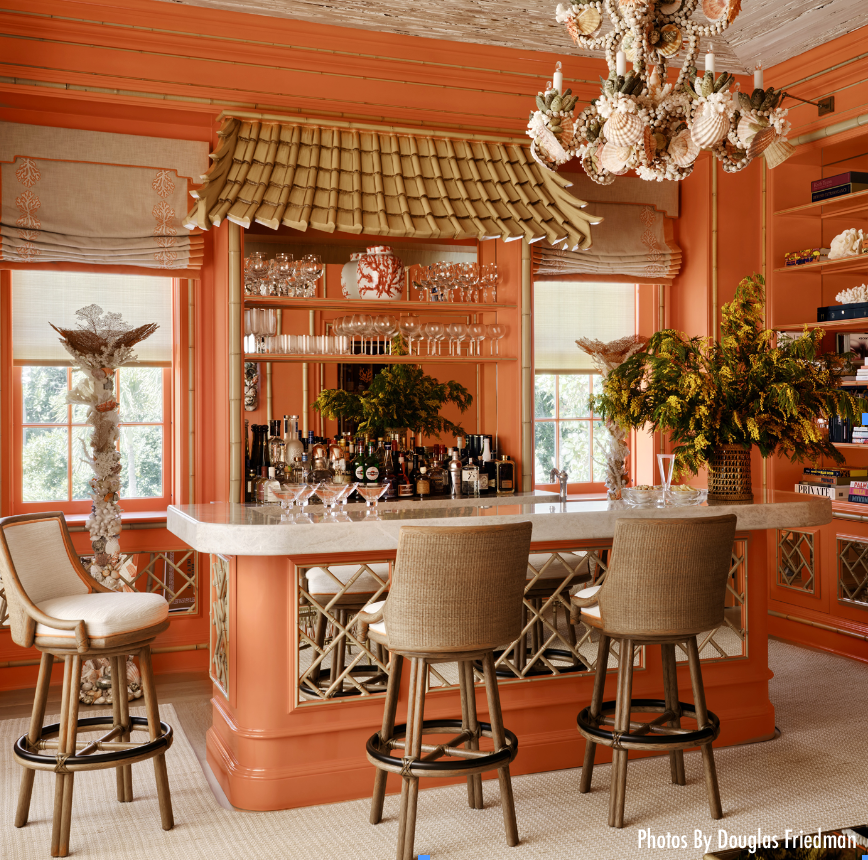
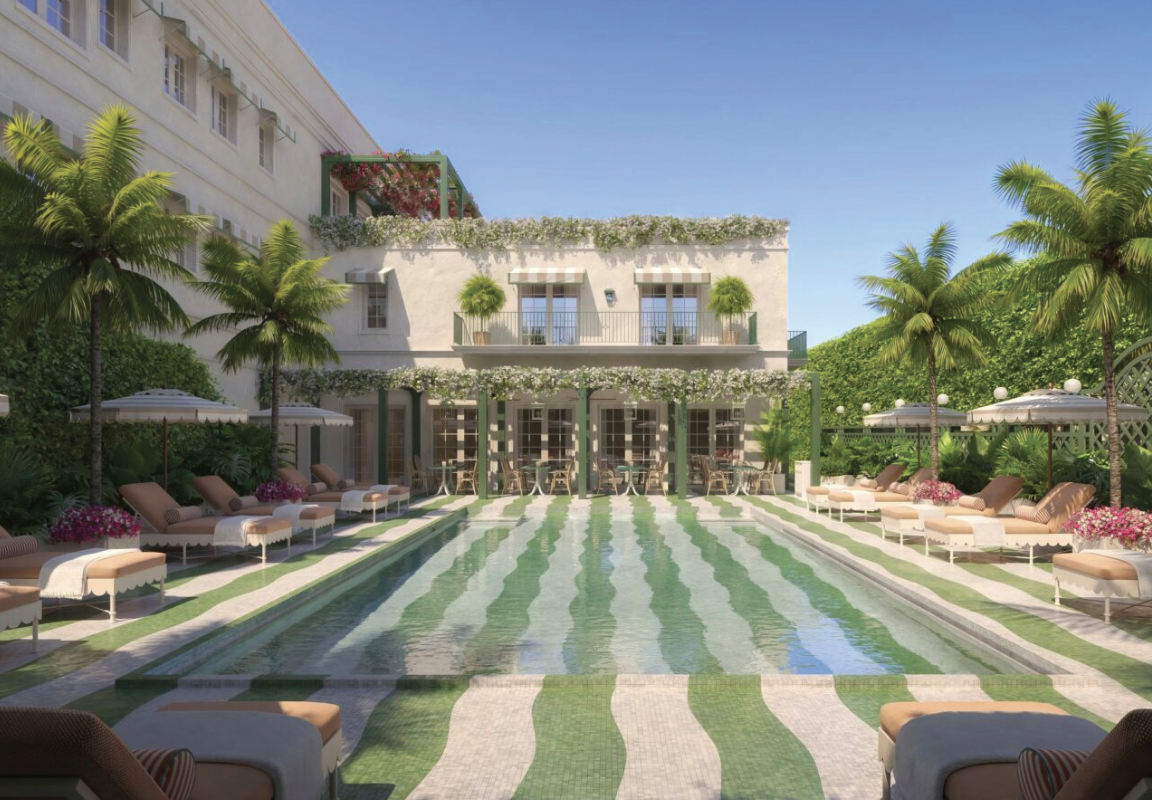
We speak mid-morning. He is in the South of France. The day before, Spain. The day before that, Greece. The movement is constant, yet it never registers as hurried. If anything, it suggests a particular kind of precision—an ability to move across places, time zones, and commitments with a calm that feels entirely his own.
Palm Beach comes up early. It is a place he has known for decades, though not continuously, and one that I have returned to with a renewed perspective. Palm Beach is not being reinvented; it is expanding—families long embedded in its fabric evolving alongside a new wave of arrivals, introducing different ways of living and a distinct new energy.
“It’s true,” he says. The observation lands without emphasis. Simply acknowledged.
He speaks of Palm Beach with familiarity, not sentimentality—an understanding shaped over time rather than defined in a single moment.
When he was first asked to look at what would become the Vineta, the building revealed itself as a property shaped by successive iterations. Originally from the 1920s, it had accumulated decisions, adjustments, and inheritances—some enduring, others less resolved—requiring not just attention, but discernment.
“It was going to be a tall order,” he says.
The project required discipline. Structural limitations and the realities of regulatory considerations in Palm Beach—where, as he notes, even modest changes are subject to careful review—meant that every move had to be considered. Progress was measured. Decisions were deliberate.
This was not cosmetic. It was a rethinking.
The ambition, as he describes it, was clear: to bring a building rooted in another era forward—“from the 1920s to the 2020s”—without losing its identity.
A key part of that process was his collaboration with Debra Reuben, who served as both client and sounding board throughout. He speaks of her as integral to the process—an engaged and intuitive presence who understood the ambition of the project and supported it. “She was a great ally,” he says.
The Vineta does not announce itself. It doesn’t try to impress you into submission. It feels, rather, like stepping into someone’s home—someone with impeccable taste, certainly, but also someone who understands that comfort and elegance are not opposites.
“It’s a feeling,” I tell him. “Yes,” he says. “It’s a nuanced one.”
The distinction matters.
Because what has been missing—not just in Palm Beach, but across much of contemporary hospitality—is precisely that: nuance. Not decoration, not excess, but the calibration of how a space is experienced over time. He describes it, almost reluctantly, as “a satisfying environment… where everything feels like everyone cares about what things feel and look like.” The language is understated. The outcome is not.
His ability to do so feels less like a strategy and more like the natural consequence of a life lived across cultures. Born in London. A French education. A Greek-Egyptian father. An Irish mother. A household defined by movement, conversation, and a deeply social life. People coming and going. Meals, gatherings, exchange. It gave him, he says, “an open-minded way of looking at life… to absorb all influences, always.”
There is no rigidity in his references, no single aesthetic he returns to out of habit. Instead, there is a kind of fluidity—a willingness to let different histories, different sensibilities, coexist.
You see it in his work. A medieval castle in the Alps. Palazzos in Italy. A project in the Brazilian jungle. Contemporary architecture in Tokyo. Each project resolves itself on its own terms, without insistence.
When I ask if there is anything left undone, he pauses.
“There are probably a thousand things I still feel I’ve not done.”
What draws him is not completion, but the beginning. Each new project carries the possibility of something not yet experienced—a new client, a new architect, a new collaboration taking shape. It is that sense of anticipation, of not yet knowing, that continues to hold his attention. “The trepidation of a new project is what is inspirational,” he says.
There is, in the way he moves through the world, an ease that cannot be engineered—something instinctive, considered, and entirely unforced. Effortless, but not accidental.
He references a French expression—atomes crochus. Connected atoms. The idea that certain affinities simply reveal themselves. In his case, it seems as true of projects as it is of people.
As we finish, he mentions the response to the hotel—almost in passing, as if still surprised by it.
“I’ve had a very sweet number of messages,” he says. “Kind, complimentary—flattering, even, though they’re really about the hotel.” He pauses, then adds, with a quiet sincerity, “I have to say, I’m rather amazed and surprised and delighted.”
He leaves it there, without embellishment. “I’m pleased people are enjoying it.”
Because what Zervudachi creates does not seek attention.
It accrues it.
And in doing so, it offers something increasingly rare: the sense that a place has been understood—quietly, precisely, without excess—and that, somehow, you recognize it the moment you arrive.